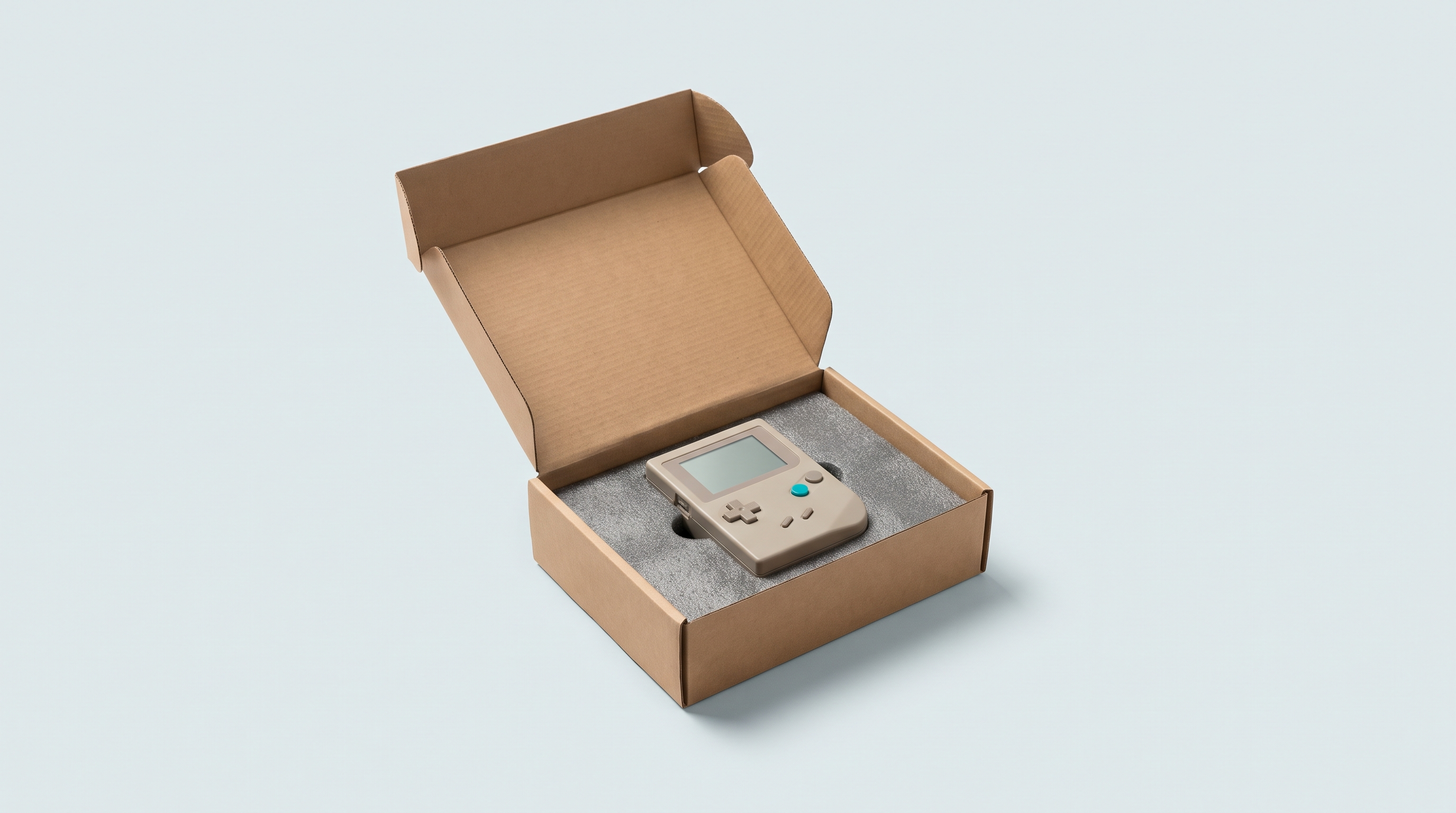
On marketplaces, the same console is sold twice: a bare version, and a "10,000 games included" version that costs barely more. We sell the first one. Always. None of our consoles ships with a commercial game on it, and none of our microSD cards contains a game file.
This isn't an oversight. It's a choice, with a cost we accept. Here's what lies behind it, and what we put in the box instead.
What you're really buying with a "10,000 games" console
These games are not given away by their publishers. They are unauthorised copies of protected works. And counterfeiting isn't only about manufacturing: under French law, article L335-2 of the Intellectual Property Code also covers the sale, import and possession of counterfeit goods, and provides for up to three years' imprisonment and a €300,000 fine.
They are therefore goods that customs can detain. European Regulation 608/2013 applies to everything entering the territory of the Union, including small parcels addressed to private individuals: a parcel can be held, then destroyed if the infringement is established. You then have neither the console, nor the games, nor necessarily anyone to refund you. It doesn't happen to every parcel, but the risk falls on the buyer, and no seller can guarantee you otherwise.
The seller who preinstalls is rarely the one who repairs
There's a second, more down-to-earth problem. A seller who takes this risk rarely stands behind it over time: direct shipping, no French invoice, a shop name that changes twice a year.
When the joystick drifts or the battery swells, you need a seller you can reach, an invoice and a 2-year legal guarantee of conformity enforceable in France. That's exactly what disappears with here-today-gone-tomorrow shops. Our name is on the invoice, customer service is in France, the guarantee runs for two years — and that's only worth something if we're still here in two years.
What French law says, in brief
First point: the backup copy. Under French law, section II of article L122-6-1 of the Intellectual Property Code provides that "the person having the right to use the software may make a backup copy where this is necessary to preserve the use of the software". This applies to software, and to your own copies.
Second point: a video game isn't just software. The French Court of Cassation, in its ruling of 25 June 2009 (First Civil Chamber, No. 07-20.387), describes it as a "complex work", made up of elements subject to different legal regimes. To date, no French court decision has settled the question of copying a cartridge you own. The subject remains debated.
Third point, and this one is perfectly clear: downloading a ROM is counterfeiting, even if you own the original cartridge. Since 2011, article L122-5 2° has limited the private copy exception to copies "made from a lawful source". A file obtained from a third-party site isn't one. Owning the original gives you no right to download.
What we prepare instead, on every console
So no games, but not a bare box either. On every console that leaves our premises:
- the firmware is checked and updated if the manufacturer offers a newer version; our compatibility table shows what the machine supports;
- the microSD card is formatted and then checked with a full write-and-read-back pass, which rules out fake capacities;
- the folder structure is in place, ready for your files (details in our guide to paths by firmware);
- buttons and controllers are checked one by one, sticks and triggers included;
- the menu is in French when the firmware allows it, which isn't the case for all of them;
- a getting-started guide comes with the console, and the product page states its condition on delivery: ready to play, to be configured, or Windows to set up.
So we prepare everything that concerns the machine. The content is yours, and there are several legal ways to get it.
The four legal routes, in summary
| Route | What you get | What it takes |
|---|---|---|
| Copying your own cartridges | Your games, exactly as you bought them | A cartridge reader, time, and the caveats above |
| Official subscriptions | Retro catalogues maintained by the publishers | An account, a recurring payment, and the right hardware for the service |
| Re-releases and compilations to buy | Titles you own for the long term, with display options and saves | One purchase per title or per compilation |
| Homebrew and free games | Recent creations, free or paid | A download from the official source |
Each has its limits, detailed on the Where to play legally page. For the first, our cartridge copying guide explains the hardware and formats, system by system.
What this choice costs us
Let's be honest: it costs us sales. Between two listings at the same price, one of which promises thousands of games, buyers rarely choose ours. It also costs us time in customer service, and sometimes a negative review.
We do it anyway because a stock of seizable goods is a risk we don't want anyone to bear, because a shop still open in five years is more useful than one that closes after two, and because these games have authors, some of whom are still working.
If you're looking for a seriously prepared machine, with a microSD card checked before shipping, the selection is here: all our retro handheld consoles.
Frequently asked questions
Can you install games before shipping, even if I provide them?
No, under no circumstances. We don't copy any game files onto the consoles or cards we sell, whatever their stated origin. We can't verify whether a source is lawful, and we don't want to have to.
Is the console unusable when it arrives?
No. It boots, the menus work, the controls are configured and the folder structure is ready. All that's missing are your game files, to be copied onto the card.
I own the original cartridge, can I download the corresponding ROM?
No. Since 2011, the private copy exception has required a lawful source, and a third-party download site isn't one. Owning the original gives you no right to get the file elsewhere. It's the least debatable point of the whole subject.
I've already bought a preloaded console elsewhere, what should I do?
We can't give you legal advice. In practical terms, the content of the card has no bearing on the warranty: the seller won't replace the machine on that basis. A new, verified microSD card is still a good idea, since the ones supplied are of unknown quality.
Do you sell microSD cards with games on them?
No, never. Our cards are sold empty, formatted and checked with a full write-and-read-back pass. That's the only content we guarantee: storage space that really delivers what it advertises.
What does a buyer actually risk?
Counterfeiting also covers import and possession, and customs can detain a parcel on entry into the European Union, small parcels included. In practice, the most common risk is losing the parcel and what you paid for it. For a specific situation, talk to a lawyer, not a seller.