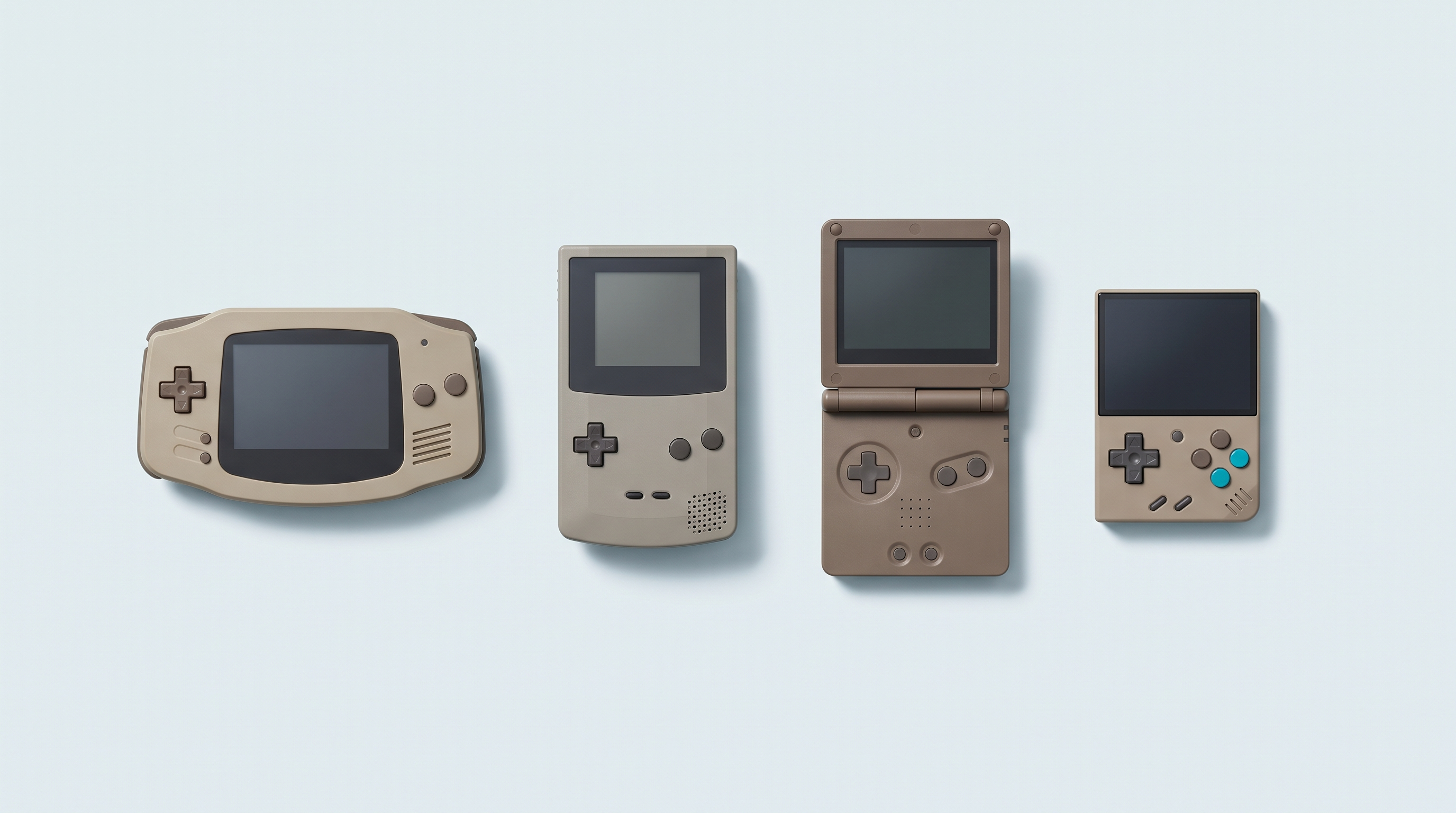
Two consoles can have the same chip, the same screen and the same firmware, and feel completely different. What sets them apart is how they sit in your hands. A vertical device is held like a phone: your thumbs work inwards and your wrists stay close together. A horizontal device with grips spreads your hands apart and relieves your forearms. After twenty minutes, you notice the difference. After two hours, it decides whether you put the console down or not. The form factor also dictates what you carry, where you store it, and what happens to the screen when the console travels at the bottom of a bag.
Why form factor matters more than the spec sheet
People readily compare processors, resolutions and battery capacities. These criteria describe what the console can do, not what you will actually do with it.
The form factor, on the other hand, makes itself felt in every session: the spacing of your hands, the position of your thumbs on the D-pad, how easy the triggers are to reach, the room available for sticks, the space taken up in a pocket. No firmware update can fix a form factor that doesn't suit you.
The good news: within the same generation, the chips are often identical from one form factor to another. The Allwinner H700 powers vertical and horizontal models alike, as well as clamshell and square ones. So you don't have to choose between comfort and performance. Our comparison tool lets you filter on these two criteria separately.
The four form factors in detail
Horizontal, Game Boy Advance style
Screen in the centre, controls on either side. This is the most common layout, and the closest to a controller.
Ergonomics. Your hands naturally sit on either side of the body, which keeps your wrists in line with your forearms. It is the only form factor wide enough to fit two well-spaced analogue sticks and four stacked triggers. Some models add contoured grips on the back: the weight then rests on your palms instead of being pinched between your fingers.
Long sessions. This is where the horizontal format takes the lead. A two-hour session is noticeably less tiring than on a vertical device of equivalent weight.
Portability. The weak point. A horizontal device is wide: the Anbernic RG 477M is 176 mm long and weighs 354 g, while the Anbernic RG35XX Pro stays more compact at 128 × 81 × 22 mm and 191 g. The first travels in a bag, the second still fits in a large pocket.
Screen protection. None, by design. The screen is always exposed, so you need a sleeve or a case.
In our range. On Linux: Anbernic RG35XX Pro (€96.99), RG35XX H, RG40XX H, RG34XX with its 3.4-inch 720 × 480 screen, TrimUI Smart Pro and its 4.96-inch 16:9 screen, Powkiddy X55. On Android: the whole Retroid Pocket 4 Pro, 5 and 6 range, the Anbernic RG557 and the RG 477M.
Vertical, Game Boy style
Screen at the top, D-pad and buttons below. The original handheld gaming form factor.
Ergonomics. Your hands frame the bottom of the body and your thumbs converge towards the centre. The grip is instant and requires no learning. On the other hand, your wrists stay close together and the weight is spread over a smaller area.
Long sessions. Fine for an hour, more debatable beyond that, especially on the heaviest models. The vertical format is better suited to short, repeated sessions than to marathons.
Portability. Its home turf. The Miyoo Mini Plus (€92.99) measures 108 × 78.5 × 22.3 mm and weighs 162 g, the TrimUI Brick (€114.99) weighs 159 g, and the Anbernic RG28XX goes down to 125 g with a thickness of 16.5 mm. These are the only devices you take along without even thinking about it.
Screen protection. None either, and the screen often takes up the entire front: the risk of scratches in a pocket is real with keys alongside.
In our range. Miyoo Mini Plus, TrimUI Brick, Anbernic RG40XXV (€109.99, 139 × 92 × 22 mm, 216 g), RG28XX, Powkiddy RGB20S. On Android: Anbernic RG406V and RG 477V, the latter with a 4.7-inch 4:3 screen at 1280 × 960.
Clamshell, Game Boy Advance SP or Nintendo DS style
Two halves joined by a hinge. Screen on one side, controls on the other.
Ergonomics. Similar to the vertical format once opened, with an adjustable screen angle, which helps a lot outdoors or under direct lighting. The hinge adds a few millimetres of thickness, which sometimes gives a better fit in the palm.
Long sessions. Comparable to the vertical format. The adjustable angle, however, saves you from bending your neck, a detail that matters after an hour.
Portability. A clamshell halves its length when closed: the Anbernic RG35XXSP measures 89 × 85 × 27 mm folded and weighs 192 g. It becomes almost square and slips into a coat pocket. The Retroid Pocket Flip 2 is bulkier: 140.5 × 89.5 mm, between 24.4 and 31 mm thick, 300 g, but it encloses a 5.5-inch 1920 × 1080 AMOLED screen.
Screen protection. The only form factor that truly protects it, see below.
In our range. Anbernic RG35XXSP on Linux, Retroid Pocket Flip 2 on Android, and the Anbernic RG DS for the special case of dual screens: two 4-inch 640 × 480 panels, one of them a touchscreen, 160 × 91 × 21.5 mm and 321 g.
Square
A 1:1 screen, as tall as it is wide. A rare, recent form factor.
Ergonomics. The body is wider than a classic vertical device with the same diagonal, which spreads your hands slightly. The RG CubeXX has rounded sides that fill the palm, a different approach from Anbernic's usual flat edges.
Long sessions. Somewhere between vertical and horizontal, without the room of a true body with grips.
Portability. The unusual width doesn't suit a trouser pocket. It is a bag or sofa device.
Screen protection. None.
In our range. Anbernic RG CubeXX, 3.95-inch 720 × 720 screen, Allwinner H700 chip, 3,800 mAh battery rated for around 6.5 hours. It is currently the only square model in our range.
| Form factor | What it offers | Its limitation | Who it's for |
|---|---|---|---|
| Horizontal | Hands spread apart, room for two sticks and four triggers, best comfort beyond an hour | Wide, almost never pocketable | Long sessions, PS1 and more recent systems |
| Vertical | The most compact and lightest, instant grip | Wrists close together, sticks absent or poorly placed depending on the model | Short journeys, 8- and 16-bit, arcade games |
| Clamshell | Screen protected when closed, adjustable screen angle, footprint halved | The hinge and ribbon cable are wear parts, greater thickness | Daily commute, backpack, coat pocket |
| Square | Displays 4:3 and vertical games without wasting the panel | Only one model available, impractical width | Vertical arcade, puzzle games, unapologetic curiosity |
Form factor and emulated system: what goes together
There is a simple logic behind these four designs, and it comes down to the number of controls a game requires.
A Game Boy, NES, Super Nintendo or Mega Drive game is played with a D-pad, two to six buttons and two triggers. A vertical device is more than enough, and its compact size becomes a real advantage. From the PlayStation 1 onwards, things change: games use two sticks and four triggers, and sessions last longer. The horizontal format takes the lead again, simply because it has the physical room to fit everything properly. The same reasoning applies to the Nintendo 64, the Dreamcast, and then the PSP and PlayStation 2 on Android. Our guide to PlayStation 1 emulators on handheld consoles covers the software side in detail.
Arcade is the case that justifies the square format. Some arcade cabinets from the 1980s and 1990s displayed a vertical image, taller than it was wide: shoot 'em ups, but also Pac-Man and Donkey Kong. On a 16:9 screen, these games shrink to a central strip flanked by two huge black areas. On a 4:3 screen, it's already better. On a 1:1 screen, the panel is used in both directions depending on the game's orientation.
The clamshell, the only form factor that protects the screen
This is its main selling point, and it is a concrete one. When closed, a clamshell turns its panel face-down against the shell. No other form factor does that. On a vertical or horizontal device, the screen is exposed as soon as it leaves its sleeve, and a bunch of keys in the same pocket always ends up leaving a mark.
Two trade-offs to know about before buying. The hinge is a mechanical part subjected to thousands of cycles, and the ribbon cable connecting the screen to the motherboard runs through it: these are the wear points of every clamshell, past and present. A clamshell is also thicker for the same diagonal: 27 mm for the folded RG35XXSP versus 22 mm for an RG35XX Pro.
If you stick with an open form factor, the reflex is a hard case. Our sleeves and cases section covers the common sizes.
Choosing based on where you play
The sofa, in the evening
Go for a horizontal device, ideally with grips. Weight hardly matters since your arms are resting: comfort over time becomes the only criterion. An RG35XX H, a TrimUI Smart Pro or a Retroid Pocket 5 fits the bill, and this is the setting where a large screen makes sense.
Public transport, every day
A clamshell, or a vertical device with a sleeve. On a train or bus, you open and close the console ten times per journey: the clamshell is made for that rhythm, and the screen is safe between stops. The RG35XXSP is the best suited in our range for this use, the Retroid Pocket Flip 2 if you are aiming for PSP or PlayStation 2.
The jacket pocket
Only the vertical format really fits. The Miyoo Mini Plus and the Anbernic RG28XX are the two pocket-sized models in our range. Be careful, though: a body 16 to 22 mm thick is still vulnerable in a back pocket, and nothing protects the screen. A soft case costs a few euros and prevents a permanent scratch.
What about hybrid form factors?
The Anbernic RG Slide slides its upper half open like a PSP Go: 154 × 90 × 26 mm and 379 g. The mechanism protects the controls, not the screen, and you feel the weight. These are niche devices, chosen for a specific reason rather than for their versatility.
FAQ
Does a vertical form factor limit performance?
No. Form factor and chip are two separate things: the same Allwinner H700 powers vertical, horizontal, clamshell and square models from Anbernic. What the vertical format limits is the number of controls available and comfort during long sessions, not processing power.
Can you play PlayStation 1 games on a vertical console?
Yes, PS1 emulation runs on all the recent Linux devices in our range, whatever their form factor. The problem lies elsewhere: many late PS1 games require two analogue sticks, which compact vertical devices don't always have. Check whether sticks are present and how they are placed before buying.
Does a clamshell hinge always end up breaking?
It is one of the parts that wear, just as on the original clamshells. Normal use causes no problems over the length of a guarantee, but opening the console with one hand by forcing a corner strains the hinge and the screen ribbon cable. Open it with both hands, from the centre.
Which form factor for arcade and vertical shoot 'em ups?
A square or 4:3 screen, rather than a 16:9 screen that leaves huge black bars on vertical games. The RG CubeXX and its 720 × 720 screen are the best placed in our range for this use. Rotating the image by 90 degrees, however, depends on the firmware and its version.
Do you need a sleeve even with a clamshell?
It is still useful, but for other reasons: knocks, dust and scratches on the outer shell. The clamshell solves the most expensive problem, a scratched screen, which is enough for many everyday uses.
Can you try a form factor before committing?
Rarely in a physical shop in France. The most reliable guide remains dimensions and weight: compare them with a device you already hold in your hand, a phone or a controller. A difference of 100 g really changes how it feels. Our contact page is open if you are torn between two specific sizes.
Where to start
First answer one question: where will you play most often? The form factor follows almost automatically, and the level of emulation is chosen afterwards, without one constraining the other. If you are still torn between the two main families of systems, our Android or Linux comparison and our Anbernic or Retroid Pocket article cover the question from the software and brand angles.
Every product page in our range states the device's condition on delivery, ready to play or to be set up, so you know what to expect when you open the box. All four form factors are gathered in our handheld consoles section.