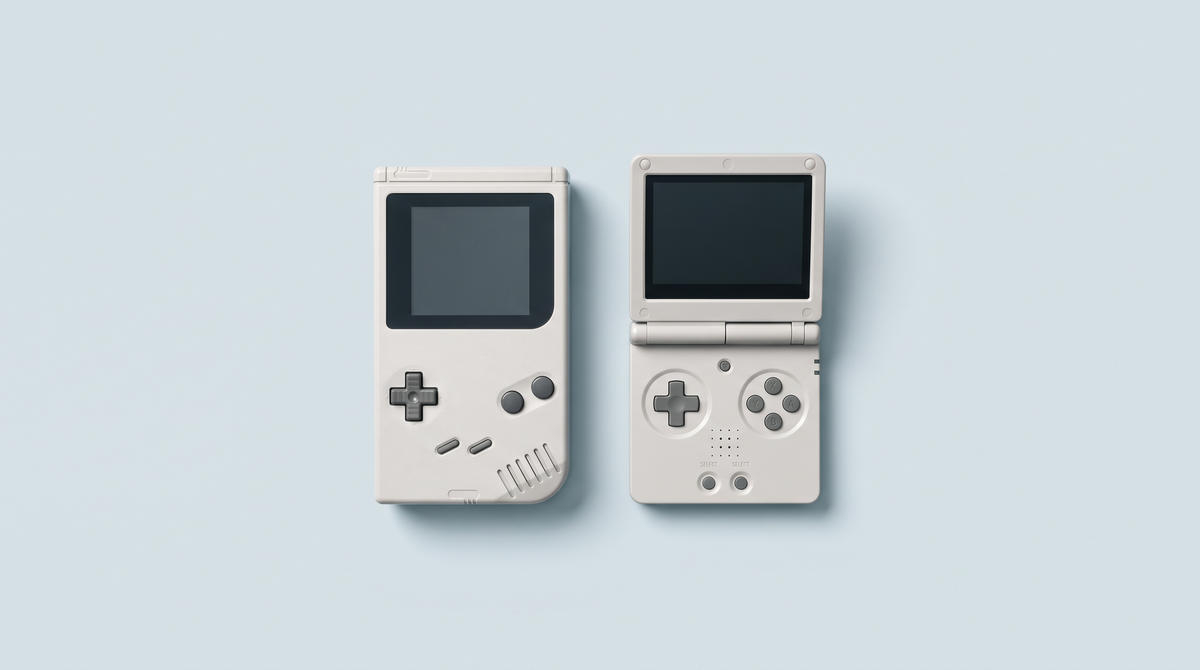
These two consoles start from opposite ideas. The Anbernic RG 477V bets on a 4.7-inch 4:3 screen, cut out for the pre-2000 catalogue. The Retroid Pocket Flip 2 folds a 5.5-inch 16:9 AMOLED into a clamshell that protects the panel. You are not choosing between two levels of power, but between two ways of holding a console. Here is what their spec sheets say.
Comparison table
| Specification | Anbernic RG 477V | Retroid Pocket Flip 2 |
|---|---|---|
| Screen type | LTPS Incell (OCA lamination) | AMOLED |
| Size and aspect ratio | 4.7” in 4:3 | 5.5” in 16:9 |
| Resolution | 1280 × 960 | 1920 × 1080 |
| Refresh rate | 120 Hz | — |
| Brightness and touch | 500 nits / Multi-touch | — |
| Chipset | Unisoc T820 | Qualcomm Snapdragon 865 |
| GPU | Quad-core Mali-G57 850MHz | Qualcomm Adreno 650 |
| RAM | 8 GB LPDDR4X | 8 GB LPDDR4X |
| Storage | 128 GB UFS 2.2 | 128 GB UFS 3.1 |
| Battery | 5500 mAh (lithium polymer) | 5000 mAh |
| OS listed on the spec sheet | Android 14 | — |
| Weight | 250 g | 300 g |
| Dimensions | 165 × 86 × 18 mm | 140.5 × 89.5 × 24.4 - 31 mm |
| Sticks | Two, at the bottom of the console | Two, symmetrical |
| Wi-Fi / Bluetooth | 2.4/5G (802.11a/b/g/n/ac/ax) / 5.0 | 6 / 5.1 |
The dashes correspond to specifications the product page does not document: the Flip 2's sheet states neither its refresh rate, nor its brightness, nor its operating system.
Screen and aspect ratio
The RG 477V shows a 4.7-inch LTPS Incell panel at 1280 × 960, in 4:3, OCA laminated, rated at 500 nits, multi-touch and running at 120 Hz. The Flip 2 answers with a 5.5-inch AMOLED at 1920 × 1080, 16:9, 400 PPI.
The Flip 2 has more pixels and the better panel technology, but the aspect ratio changes everything. A SNES, Mega Drive or PS1 game fills the whole surface on the RG 477V; on the Flip 2 it occupies a central square framed by black bars. Conversely, PSP or PS2 games designed in 16:9 make full use of the Flip 2.
Verdict
The RG 477V wins. The retro catalogue is overwhelmingly 4:3, and it alone displays it without compromise — with the added bonus of being the only one in this duel with documented refresh rate and brightness figures.
Power and emulation
The RG 477V is built on a 6 nm Unisoc T820, eight Cortex-A76 and A55 cores, a quad-core Mali-G57 GPU at 850 MHz, 8 GB of LPDDR4X and 128 GB of UFS 2.2. The Flip 2 uses a Snapdragon 865, Cortex-A77, an Adreno 650 GPU at 587 MHz, 8 GB of LPDDR4X and 128 GB of UFS 3.1.
Both spec sheets announce the same range: PS2, GameCube, Wii, 3DS, Saturn, PSP, Dreamcast, N64, DS, PS1 and up to the SNES. They diverge on one point: the Flip 2 lists the Switch with caveats, the RG 477V lists it as not supported. For the PS2 and the GameCube, the same warning applies to both: these systems are announced as playable, not as fully compatible.
Verdict
The Flip 2 wins. Its UFS 3.1 storage is faster than the RG 477V's UFS 2.2, and its spec sheet is the only one of the two to leave the door ajar on the Switch.
Ergonomics and form factor
The RG 477V weighs 250 g for 165 × 86 × 18 mm: a flat, even slab, D-pad on top, twin sticks at the bottom of the console, stacked shoulder buttons, plus Hall-effect analogue triggers, a 6-axis gyroscope, touch and active cooling.
The Flip 2 weighs 300 g for 140.5 × 89.5 × 24.4 - 31 mm: 25 mm shorter, but noticeably thicker, the mechanical price of the hinge. Its D-pad sits at the bottom, its sticks are symmetrical. With the D-pad on top, your left thumb falls on it naturally, which serves 2D; with the D-pad at the bottom, the left stick takes the prime spot, which serves 3D.
Verdict
The RG 477V wins. It is 50 g lighter, almost twice as slim, and its D-pad is better placed for retro. The Flip 2 keeps the advantage in storage, not in comfort over a long session.
Battery
The RG 477V announces 5500 mAh in lithium polymer, the Flip 2 5000 mAh. Both spec sheets stop at capacity and give no play time; we will not invent any.
Those 500 mAh do not mechanically translate into longer battery life: the RG 477V powers a 120 Hz panel and active cooling, while the Flip 2's AMOLED draws less the darker the image is.
Verdict
The RG 477V wins on the only comparable figure, 5500 mAh against 5000, i.e. 10% more capacity. Since no spec sheet takes us further, that is the only defensible call.
Operating system
This is the criterion where the information gap is total. The RG 477V's spec sheet explicitly documents Android 14; the Flip 2's lists no system, and we will not infer it on its behalf.
This is not a detail: the Android version determines whether recent emulators can be installed and whether a frontend can be used. Both machines also announce a video output, but only the RG 477V specifies its resolution.
Verdict
The RG 477V wins for a verifiable reason: it is the only one whose system version is documented. On a purchase where your game library depends on that version, the information has concrete value.
Build
The Flip 2 puts forward an AMOLED panel, UFS 3.1 storage, Wi-Fi 6, Bluetooth 5.1, front-facing stereo speakers and cooling. Its hinge is the most demanding manufacturing element in this duel.
The RG 477V counters with an OCA-laminated panel, front speakers described as high-fidelity stereo, RGB lighting, a 1080p video output, an SD card reader accepting up to 2 TB and Wi-Fi 802.11a/b/g/n/ac/ax. Its Bluetooth stays at 5.0 against 5.1, and its storage at UFS 2.2 against UFS 3.1. Both shells are plastic.
Verdict
The Flip 2 wins. AMOLED, UFS 3.1 and Bluetooth 5.1 are three documented advantages on key components, and the clamshell protects the screen at all times.
Which one to choose for your profile
You mainly want 2D and the PS1
Take the RG 477V, without hesitation. Its 4:3 screen at 1280 × 960 displays SNES, Mega Drive, Game Boy Advance and PlayStation 1 games in their original frame, across the whole panel. Its D-pad on top is in the right place for these titles, and its 120 Hz smooths out the scrolling. On the Flip 2, those same games lose a large part of the screen to black bars.
You are aiming at the PS2 and the GameCube
Take the Retroid Pocket Flip 2. These generations produced games designed for a wide screen, which its 1920 × 1080 AMOLED renders without cropping, and its UFS 3.1 storage loads faster than the RG 477V's UFS 2.2. Bear in mind that compatibility will remain partial whatever the hardware.
You play on your commute
Take the Flip 2. It is the only form factor in this duel that folds the screen onto the controls: it goes into a bag with no case and no worry for the panel, and its 140.5 mm folded fit in a jacket pocket. The RG 477V is 50 g lighter and far slimmer at 18 mm, but its screen stays exposed, which makes a case mandatory.
Frequently asked questions
Is a 4:3 screen really an advantage?
Yes, for the entire catalogue designed before 16:9 arrived. In 4:3, a SNES or PS1 game occupies the whole panel. On a 16:9 screen, you have to choose between black bars or a stretched image that distorts the sprites. For the PSP or the PS2, the advantage flips.
Does the Retroid Pocket Flip 2 run on Android?
Its spec sheet does not document an operating system, so we will not claim one. What it does list is a touchscreen, a gyroscope, Wi-Fi 6 and Bluetooth 5.1. For the RG 477V, the system is explicitly stated: Android 14. Check this point on the product page before ordering.
Is the clamshell hinge a weak point?
Mechanically it is the most heavily used part of the Flip 2, and its spec sheet gives no number of opening cycles. In exchange, it protects the screen when the console is closed, which removes the risk of scratches in a bag. The RG 477V has no moving part, but leaves its panel exposed.
Which one has the better real-world battery life?
The spec sheets only give capacities: 5500 mAh for the RG 477V, 5000 mAh for the Flip 2. Neither quantifies a play time, which in any case depends on the emulated system, the brightness and the display mode. On the only figure available, the RG 477V has 10% more reserve.
Conclusion
The RG 477V is the retro purist's machine: native 4:3, 120 Hz, D-pad on top, 250 g and a documented operating system. The Flip 2 is the daily commute machine: 1080p AMOLED, UFS 3.1 and a lid that replaces the case. If your library stops at the PlayStation 1, the first wins every time; if it climbs up to the PS2, the second is the better tool.
Have a look at the pages for the Anbernic RG 477V and the Retroid Pocket Flip 2, then refine your choice with our handheld console comparison tool.