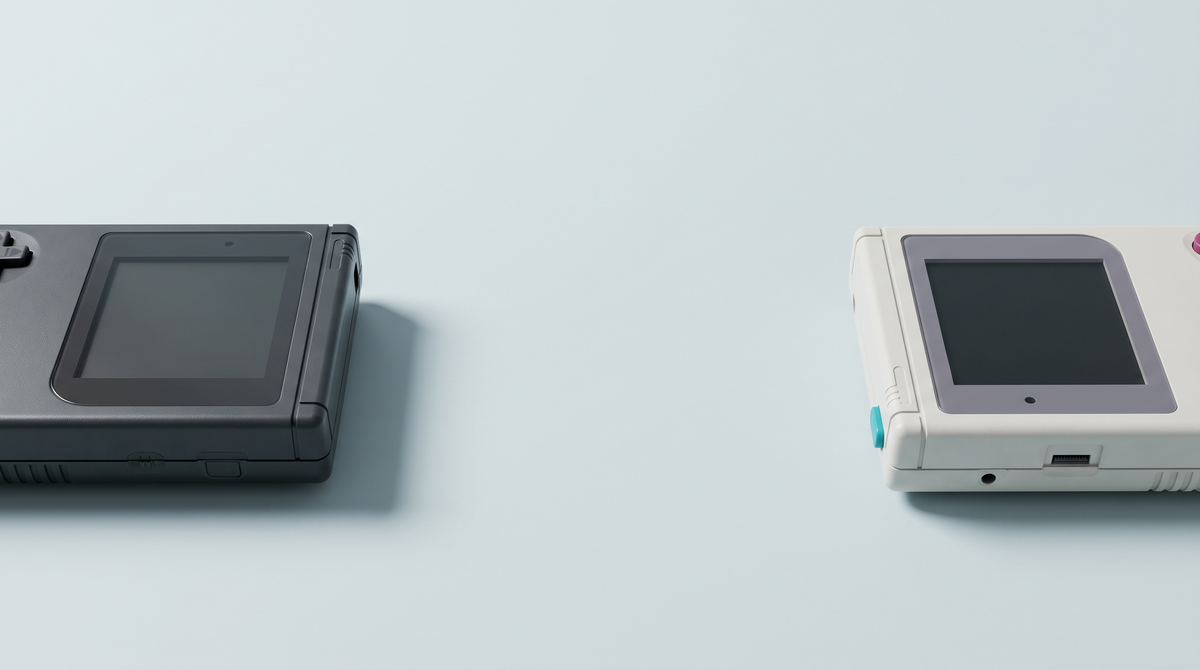
You are torn between the two names that come up in every discussion about portable retro gaming, and the contradictory opinions are no help. The question is not which one is "the best": they are not aimed at the same buyer. Anbernic casts a wide net, from a pocket-sized Linux box to high-end Android, with a variety of screen formats. Retroid Pocket keeps its range tight, around a handful of very polished Android machines. Here is the comparison, spec sheets in hand.
Comparison table
| Specification | Anbernic RG35XX H | Anbernic RG 477V | Anbernic RG557 | Retroid Pocket 5 | Retroid Pocket Flip 2 |
|---|---|---|---|---|---|
| Screen | IPS 3.5” | LTPS Incell (OCA lamination) 4.7” | AMOLED 5.48” | AMOLED 5.5” | AMOLED 5.5” |
| Aspect ratio | 4:3 | 4:3 | 16:9 | 16:9 | 16:9 |
| Resolution | 640 × 480 | 1280 × 960 | 1920 × 1080 | 1920 × 1080 | 1920 × 1080 |
| Chipset | Allwinner H700 | Unisoc T820 | MediaTek Dimensity 8300 | Qualcomm Snapdragon 865 | Qualcomm Snapdragon 865 |
| GPU | Mali-G31 MP2 | Quad-core Mali-G57 850MHz | Mali-G615 MC6 | Qualcomm Adreno 650 | Qualcomm Adreno 650 |
| RAM | 1 GB | 8 GB LPDDR4X | 12 GB | 8 GB | 8 GB |
| Storage | Dual external microSD | 128 GB UFS 2.2 | 256 GB UFS 4.0 | 128 GB UFS 3.1 | 128 GB UFS 3.1 |
| Battery | 3300 mAh | 5500 mAh (lithium polymer) | 5500 mAh | 5000 mAh | 5000 mAh |
| OS on the spec sheet | — | Android 14 | — | — | — |
| Weight | 180 g | 250 g | 347 g | 280 g | 300 g |
| Wi-Fi / Bluetooth | 5 / 4.2 | 2.4/5G (802.11a/b/g/n/ac/ax) / 5.0 | 6e / 5.3 | 6 / 5.1 | 6 / 5.1 |
A dash means the product sheet does not list that specification: this is notably the case for the operating system, which only the RG 477V documents.
Screen and aspect ratio
At Retroid Pocket, both machines share the same panel: a 5.5-inch AMOLED at 1920 × 1080, 16:9. Anbernic does the opposite: a 3.5-inch IPS at 640 × 480 and 4:3 on the RG35XX H, a laminated 4.7-inch LTPS Incell at 1280 × 960, still in 4:3, listed at 500 nits and 120 Hz, on the RG 477V, then a 5.48-inch AMOLED in 16:9 on the RG557.
Virtually the entire pre-2000 catalogue was composed in 4:3. On a 16:9 screen, those games show up with two black bars on the sides, or stretched.
Verdict
Anbernic wins, because it is the only one that leaves you a choice of aspect ratio. No Retroid in this comparison can display a 4:3 game full screen.
Power and emulation
The RG557 packs a Dimensity 8300, a Mali-G615 MC6 GPU at 1.4 GHz, 12 GB of LPDDR5X and 256 GB of UFS 4.0. Both Retroid Pockets rely on a Snapdragon 865, an Adreno 650 at 587 MHz, 8 GB of LPDDR4X and 128 GB of UFS 3.1. The RG 477V uses a Unisoc T820 and a Mali-G57 at 850 MHz; the RG35XX H an Allwinner H700 with 1 GB of LPDDR4.
The spec sheets for the RG557, both Retroids and the RG 477V all list PS2, GameCube, Wii, 3DS, Saturn, PSP, Dreamcast, N64, DS, PS1 and SNES. The RG35XX H stops at Dreamcast and N64, with GameCube flagged as out of reach. On these heavy systems, compatibility is never total: a spec sheet that lists PS2 is saying the system runs, not that its entire catalogue runs.
Verdict
Anbernic wins thanks to the RG557, ahead of both Retroids on GPU, RAM and storage. No Retroid in this comparison goes beyond the Snapdragon 865.
Ergonomics and form factor
Retroid standardises its controls: analogue triggers, Hall effect sticks, L3/R3, touch and gyroscope on both models. The Pocket 5 weighs 280 g and is 15.6 mm thick, the Flip 2 300 g in clamshell form.
At Anbernic, the internal gap is much wider. The RG35XX H comes in at 180 g, but its spec sheet notes the absence of analogue triggers, Hall effect, touch and gyroscope. The RG 477V brings all of that back at 250 g. The RG557 is the most imposing at 347 g and 223 mm long.
Verdict
Retroid Pocket wins. Its control hardware is identical and complete on both machines, and the Pocket 5 weighs 67 g less than the RG557 for an equivalent screen. At Anbernic, you have to move up the range to get Hall sticks and touch.
Battery life
The spec sheets give capacities, not run times, and we are not going to invent any. Anbernic lists 5500 mAh on the RG 477V and the RG557, against 5000 mAh on both Retroid Pockets. The RG35XX H drops to 3300 mAh.
A higher capacity does not guarantee longer battery life: the RG557 powers a Dimensity 8300, the RG 477V a 120 Hz panel. For identical use, a more powerful machine draws more.
Verdict
Anbernic wins on the only measurable figure, 5500 mAh against 5000. Important caveat: that advantage is partly absorbed by a hungrier processor.
Operating system
Only one spec sheet documents its system: the RG 477V, running Android 14. For the other four, the field is empty and we are not going to fill it in by guesswork. The store categories do give a reliable hint: the RG35XX H sits in Linux Retro Consoles, the RG557 and the Retroid Pocket 5 in Android Consoles.
Android opens up app stores, installable emulators and frontends. A dedicated Linux system boots faster, makes do with modest hardware and goes straight to the game selection.
Verdict
Anbernic wins on breadth: it is the only one of the two brands whose catalogue covers both entry-level Linux and high-end Android.
Build quality
Retroid takes the lead through consistency: both machines carry the same 1080p AMOLED at 400 PPI, front-facing stereo speakers, UFS 3.1, Wi-Fi 6 and Bluetooth 5.1. No cut-price model in the line-up.
Anbernic is more uneven. Its high end does better on several points: Wi-Fi 6e and Bluetooth 5.3 with UFS 4.0 on the RG557, an OCA-laminated panel at 500 nits on the RG 477V. But the RG35XX H stays on Wi-Fi 5 and Bluetooth 4.2, without stereo speakers, and its storage rests entirely on dual external microSD.
Verdict
Retroid Pocket wins. You cannot go wrong picking at random from its range; at Anbernic, the gap between the RG35XX H and the RG557 is considerable.
Which one to choose for your profile
You mainly want 2D and PS1
Go Anbernic, and specifically the RG35XX H. Its spec sheet lists SNES and earlier generations, PS1, DS, N64 and Dreamcast: exactly the target range. Its 4:3 screen shows these games with no side bars, and at 180 g it is the lightest of the five. Paying for a Dimensity 8300 to run 16-bit games would make no sense.
You are aiming at PS2 and GameCube
Go for the RG557. It beats the Retroid Pocket 5 line by line: a GPU at 1.4 GHz against 587 MHz, 12 GB of LPDDR5X against 8 GB of LPDDR4X, 256 GB of UFS 4.0 against 128 GB of UFS 3.1. On the most demanding systems, that margin is the difference between a playable game and a comfortable one. In exchange, accept the 347 g.
You play on the move
Go for the Retroid Pocket Flip 2. Its clamshell is the only format in this comparison that folds the screen onto the controls: it slips into a bag with no case and no risk of scratches. At 140.5 mm folded, it is far more discreet than the RG557's 223 mm.
Frequently asked questions
Is Anbernic more powerful than Retroid Pocket?
At the high end, yes: the RG557 and its Dimensity 8300 beat the Snapdragon 865 in both Retroids on GPU, RAM and storage. But Anbernic also sells far more modest machines, such as the RG35XX H. The brand tells you nothing about power: only the model counts.
Does Retroid Pocket offer a 4:3 screen?
Not among the models compared here: the Pocket 5 and the Flip 2 are both 16:9. If 4:3 matters to you, you need to look at Anbernic, with the RG35XX H or the RG 477V, natively 4:3 according to their spec sheets.
Can an entry-level console emulate the PS2?
No. The RG35XX H spec sheet does not mention the PlayStation 2, and explicitly flags the GameCube as out of reach. For those two consoles, you need to turn to recent Android models, and even then compatibility remains partial depending on the title.
Do you really need an AMOLED screen for retro gaming?
No. AMOLED brings deep blacks that flatter 3D, but on low-resolution 2D games the aspect ratio often matters more. The RG 477V proves it: a laminated LTPS panel, a listed 120 Hz and 500 nits, no AMOLED, for a native 4:3 image.
Conclusion
Anbernic is the choice of breadth: 4:3 and 16:9 formats, Linux and Android, from very light to very powerful. Retroid Pocket is the choice of consistency: a short, homogeneous range where every machine carries the same 1080p AMOLED and the same control hardware. If you know what you want to emulate, Anbernic will let you fine-tune it; if you don't, Retroid Pocket makes the decision simpler.
To go further: the spec sheet for the Anbernic RG557, the one for the Retroid Pocket 5, and our handheld console comparison tool.